Simple living, frugality, self sustainable, even survival or post industrial – all of these terms apply to the concept I want to talk about today. I am talking about the HAY BOX. I cannot seem to pin down when it got called that – seems to have acquired the name hay box during pioneer days. But the idea of insulated cooking goes way, way back and is also the basis for the big clay ovens that have been in use, well –forever. What is a hay box? Shockingly, it is a box filled with hay. What does a hay box do? Ah, now there is where interesting things start to happen. You start by getting a pot of water boiling hot, then you place it in the box. With an insulated lid (or more hay) on top, the pot is snuggled into the middle of the box. The hay and dead air space slows the loss of heat and keeps the water hot for a very long time. Think about it, once you get a pot boiling on the stove the only reason you need to keep the burner on is to replace lost energy. If you can slow that energy loss with insulation, then there is no need to constantly add more. That’s it I’m afraid. No magic, no convection, no microwave – but also, no more energy other than that used to boil the water.
Now why, outside of historical curiosity, would I want a hay box today? Many reasons occur to me. If you really want to practice simple, sustainable or green living, then this is for you – it reduces energy use by 75 to 90 percent. If you are frugal, the energy savings equal lower bills. If you enjoy the ease and taste of slow cooking, then the hay box delivers. If you just want to have access to a way to prepare food with a minimum of fuel used – say during a hurricane or other disaster, then the hay box is the simplest, most reliable way to stretch your cooking energy. Seriously, for such a primitive idea, it really does find its way into many modern situations.
Sunday, February 28, 2010

Friday, February 26, 2010
HOE CAKES - simple living at its best - fast food with a homestead heritage
As I try to find a simple way of living, I find myself drawn to simpler ways of cooking. A great old heirloom recipe is hoe cakes. I remember them with my nanny’s collard greens and I still relish my mom’s hoe cakes with lots of butter and dipped into homemade soups. I can think of no easier or quicker way to prepare homemade bread.

But, what exactly are hoe cakes? As our memories grow fainter and homemade food becomes more and more rare, recipes are blurred and forgotten. Many of the old recipes went by nicknames and these were muddled to start as different regional cuisines used the same label for items which sometimes wildly differed. Now, with the passage of time many names and recipes have become almost hopelessly tangled.
Hoe cakes are a perfect example. Although almost any southern family can provide you a recipe, you will also find recipes from New England and the Cherokee Indians. Frustratingly, these recipes seem to wander all over the place. Well, I am going to clarify this a little and give you a purist recipe straight from colonial times and then a slightly modified version that is great if you’re not trying for historical recreation.
Hoe cakes got their name because they were cooked on the blade of a hoe heated by a small fire. The farm hands would not always be able to return to the house for lunch. So they would carry a small pouch of cornmeal out with them to the field. When lunch time came, they would mix the meal with a little water from the fields and place the thick batter on a hoe blade that was being heated by a small hot fire of twigs. This quick, filling meal could be prepared in this manner with no fuss and get the farmer back into the field as soon as possible. This is the true hoe cake and it is similiar to the New England Johnny cake, learned from the native americans. Almost certainly, the Johnny cake was the ancestor of the southern hoe cake.

But, what exactly are hoe cakes? As our memories grow fainter and homemade food becomes more and more rare, recipes are blurred and forgotten. Many of the old recipes went by nicknames and these were muddled to start as different regional cuisines used the same label for items which sometimes wildly differed. Now, with the passage of time many names and recipes have become almost hopelessly tangled.
Hoe cakes are a perfect example. Although almost any southern family can provide you a recipe, you will also find recipes from New England and the Cherokee Indians. Frustratingly, these recipes seem to wander all over the place. Well, I am going to clarify this a little and give you a purist recipe straight from colonial times and then a slightly modified version that is great if you’re not trying for historical recreation.
Hoe cakes got their name because they were cooked on the blade of a hoe heated by a small fire. The farm hands would not always be able to return to the house for lunch. So they would carry a small pouch of cornmeal out with them to the field. When lunch time came, they would mix the meal with a little water from the fields and place the thick batter on a hoe blade that was being heated by a small hot fire of twigs. This quick, filling meal could be prepared in this manner with no fuss and get the farmer back into the field as soon as possible. This is the true hoe cake and it is similiar to the New England Johnny cake, learned from the native americans. Almost certainly, the Johnny cake was the ancestor of the southern hoe cake.
Wednesday, February 24, 2010
Banks and your money: bailouts from the taxpayer while profiteering from the poor
Overdraft fees and the latest in let them eat cake. Does anyone besides me see the irony in banks lobbying so hard to keep overdraft fees? Can anyone think of any large overdrafts lately? Not the kind measured in pennies and caused by bouncing a check at the grocer or gas station, but the kind measured in trillions and caused by greed and arrogance.
 After taking their bonuses off the top, like good little MBAs, the banks are busy right now spending money on lobbyists at the highest rate in history. No amount of our tax money is being spared in the effort to bribe our congressman into voting against the national interests in favor of the banks. Should banks be more regulated? – heck no. Should risky investment strategies continue to be backed by government guarantees as if they were pennies in a piggy bank? – of course. How about a tax on excess bonuses paid with taxpayer money? – socialist! Should banks that were “too big to fail” be broken up as part of a taxpayer bailout – communist plot!
 After taking their bonuses off the top, like good little MBAs, the banks are busy right now spending money on lobbyists at the highest rate in history. No amount of our tax money is being spared in the effort to bribe our congressman into voting against the national interests in favor of the banks. Should banks be more regulated? – heck no. Should risky investment strategies continue to be backed by government guarantees as if they were pennies in a piggy bank? – of course. How about a tax on excess bonuses paid with taxpayer money? – socialist! Should banks that were “too big to fail” be broken up as part of a taxpayer bailout – communist plot!
 But it does not stop there – having already lost any sense of shame, the bankers are now lobbying to keep their piratical overdraft fees in place. I mean – are you kidding? Banks have received bailouts worth more than centuries of their old fashioned profits. They overspent their accounts by an average of 32 to 1. All of this and yet they have the hubris to whine when congress tries to prevent them from forcing individual taxpayers into bankruptcy by charging wildly inflated fees for overdrafts. Mere humility would suffice for banks to realize how brief and small these public overdrafts appear next to the bank failures. AIG for example, received a bailout equal to 14 times the amount of profit its previous chairman had managed to earn from 1968 to 2005. Banks lost the equivalent of centuries and centuries of their total capitalist profit and the taxpayers made up for it, in one huge welfare check for the rich. Yet, despite this rather substantial overdraft, they paid no penalties – none, what so ever.
Tuesday, February 23, 2010
Earth Worms - the home garden's best friend and simple living heros
Earthworms – great ally in the home garden – a simple living solution to healthy soil in the backyard homestead. Let me tell you it is not the early bird that gets the worm, it is the wise one. There can be no one single better helper in the garden than the earthworm. They are the simple solution for simple living gardens.
Worms, not perhaps the most romantic of images. But not that many years ago, when I turned up my first worm while planting in the backyard garden, I thought – “how lovely”. Yes - lovely, oh no, not because I have some attraction to slimy crawling things. Worms were a sight for sore eyes because they meant I had healthy soil and it was going to get healthier. You see, when I bought Shadows End, it had become a very sad shadow of the bright little cottage it was when it was built for a new bride in 1924. The back garden had been turned into a white gravel “beach” for an above ground swimming pool and the only organic matter it had was cigarette butts. In truth, somehow, against all reason, a bleeding heart still clung to one corner of the house, and an old rose hunkered, sad and thorny against a corner of rotting fence. I always felt like those represented the spirit of the man and wife who had carved out a long life in this cottage. I imagined the two lone survivors of a lost garden clinging to the place they created and waiting for renewal. Waiting for the day their memories could dwell once again in a place of bright blooms and scented summer nights.
So, it was in that meaning, that I found my first worms to be lovely. For they heralded a new beginning; the conversion of that rocky, barren “landscape” into something living and fruitful again. Worms meant that the bleached horror of the gravel beach was slowly receding into the deep recesses and that real soil was forming. Well, some of the soil was being formed, but in truth, much of it was bought and paid for. Bags of cow manure and peat toted home in the trunk of my Saturn and worked into the new flower beds my friend Ray and I were creating. Some was bought and some was crafted from the leaves of the oaks which once shaded the land around my cottage. No one’s lawn clippings were safe, we would drive around and night and sweep up bags of leaves and grass and bring them back to toss into the yard. I remember how careful we were to raid only the better neighborhoods because they would be neatly bagged and free of cigarette butts or cans. Sorry for that bit of sociological snobbism – but there you have it. The great gravel desert seemed unconquerable, but little by little, soil came back to Shadows End. As I look back, it would have been easier and probably cheaper to have the backyard excavated and new soil brought in wholesale – but we did it the old fashioned way – bit by bit.
Worms, not perhaps the most romantic of images. But not that many years ago, when I turned up my first worm while planting in the backyard garden, I thought – “how lovely”. Yes - lovely, oh no, not because I have some attraction to slimy crawling things. Worms were a sight for sore eyes because they meant I had healthy soil and it was going to get healthier. You see, when I bought Shadows End, it had become a very sad shadow of the bright little cottage it was when it was built for a new bride in 1924. The back garden had been turned into a white gravel “beach” for an above ground swimming pool and the only organic matter it had was cigarette butts. In truth, somehow, against all reason, a bleeding heart still clung to one corner of the house, and an old rose hunkered, sad and thorny against a corner of rotting fence. I always felt like those represented the spirit of the man and wife who had carved out a long life in this cottage. I imagined the two lone survivors of a lost garden clinging to the place they created and waiting for renewal. Waiting for the day their memories could dwell once again in a place of bright blooms and scented summer nights.
So, it was in that meaning, that I found my first worms to be lovely. For they heralded a new beginning; the conversion of that rocky, barren “landscape” into something living and fruitful again. Worms meant that the bleached horror of the gravel beach was slowly receding into the deep recesses and that real soil was forming. Well, some of the soil was being formed, but in truth, much of it was bought and paid for. Bags of cow manure and peat toted home in the trunk of my Saturn and worked into the new flower beds my friend Ray and I were creating. Some was bought and some was crafted from the leaves of the oaks which once shaded the land around my cottage. No one’s lawn clippings were safe, we would drive around and night and sweep up bags of leaves and grass and bring them back to toss into the yard. I remember how careful we were to raid only the better neighborhoods because they would be neatly bagged and free of cigarette butts or cans. Sorry for that bit of sociological snobbism – but there you have it. The great gravel desert seemed unconquerable, but little by little, soil came back to Shadows End. As I look back, it would have been easier and probably cheaper to have the backyard excavated and new soil brought in wholesale – but we did it the old fashioned way – bit by bit.
Saturday, February 20, 2010
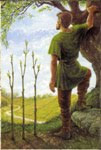
Asparagus a simple living garden perennial that can reward some basic effort with decades of healthy, delicious vegetables
 Mom, the dog is eating your ferns again – I remember that from my mother's asparagus patch and my alaskan malamute who was notorious for foraging all the backyard garden for treats at just the right edge of ripeness. She would test the tomatoes and the muscadine grapes each morning to see if they were ready and she never ate one till it was perfectly ripe. Many many gallons of grapes and almost all my mom's asparagus, disappeared into Loki's tummy. Well, the point of this post in not malamutes, although, I do love them, But, we are going to discuss asparagus. Asparagus, is one of the luxuries of simple living. The slow job of starting an asparagus bed and its place in the home garden is well rewarded in the harvest of years and years to come.
I am about to try and reestablish Asparagus in my homestead garden. My first attempt came almost 5 years ago when I tucked a few heads into a clearly wrong spot. The poor things got very little direct sun and so, of course, they sputtered around for less than a year and finally expired from lack of interest. That was a great shame- for Asparagus, like so many good things, takes an investment in time to earn its reward. It can take 3 years or more to get your first decent harvest, but if properly prepared and cared for, an asparagus bed can be productive for decades.
Asparagus is one of the very best crops one can grow under the principles of permaculture. The concept is basically that we plant permanent or long term plants and substitute efficient foraging of these crops for traditional sow and harvest agriculture. Permaculture is an attempt to minimize out need to input time and chemicals into the soil and maximize the food output. Permaculture plantings would include fruit and nut trees, perennial vegetables like asparagus, and some very alternative root and seed plants not native to our culture. Well I must say I find the idea of permanent plantings of fruit bushes and fruit and nut trees to be excellent and in keeping with the cottage garden heritage of our ancestors, On the other hand, I am not keen on the idea of most of the other plants with the exception of asparagus. But without a doubt, permaculture in general and asparagus specifically can play a good role in the simple life of a small homestead or just the backyard garden. For now, we will leave the idea of permaculture and just focus on asparagus.
Thursday, February 18, 2010
VIKING CAPITOLISM – from investors to looters - how wall street raiders destroyed American Industry and how corporations are finishing off the American economy today with a leveraged buyout of congress and one last rape of a looted economy.

Well, that was yesterday - today its Foie Gras is on the champagne buffet. Modern financial types have become the ultimate short termers, nothing matters but the quarterly profit – hell, the weekly quota. Starting way back in the 1980s, the financial class in America became addicted to short term profit. Exxon sold its headquarter building and rented it back from Japan. Boeing and GM turned over all their industrial power to China in exchange for some cheap parts to improve the end of the year bonus for a few dozen billionaires.
Capitalism was supposed to be based on investing your money in a company, buying equipment and hiring employees to produce a product and make a steady profit over time. Starting in the 80s American finance moved to a different model – modeled closely on the Viking raiders who looted the monasteries of the middle ages. The new capitalism worked something like this. You created some fake bonds with no backing whatsoever except the potential for loot. You sold those bonds. Now you used someone else’s money to buy a thriving company. Instead of investing in equipment – you pawned it off to pay back the money you borrowed. Instead of hiring employees, you fired them to reduce cost and make the company look better for a short term sale. Soon the useful parts of the company were sold off bit by bit to fill the pockets of the corporate raiders. As to producing something - what a laugh, that is a job for 9 year old chinese, not American workers.
Subscribe to:
Posts (Atom)